

17 feb. 1999
2 minuten
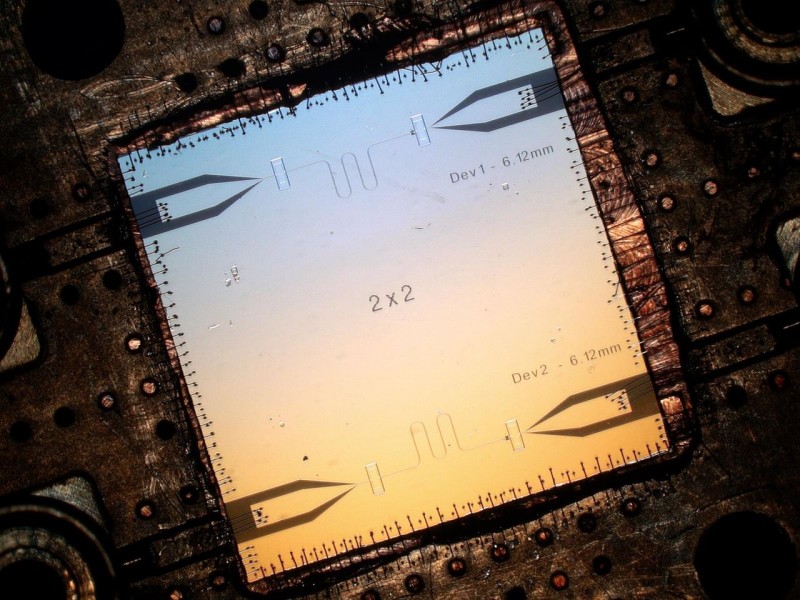
Superconducting quantum microwave circuits can function as qubits, the building blocks of a future quantum computer. A critical component of these circuits, the Josephson junction, is typically made using aluminium oxide. Researchers in the Quantum Nanoscience department at the Delft University of Technology have now successfully incorporated a graphene Josephson junction into a superconducting microwave circuit.
There are many ways of creating qubits. One of the tried and tested methods is by using superconducting microwave circuits. These circuits can be engineered in such a way that they behave as harmonic oscillators "If we put a charge on one side, it will go through the inductor and oscillate back and forth", said Professor Gary Steele. "We make our qubits out of the different states of this charge bouncing back and forth."
Graphene weak link
An essential element of quantum microwave circuits is the so-called Josephson junction. A Josephson junction can, for example, consist of a non-superconducting material, a ‘weak link’, that separates two layers of superconducting material. Pairs of superconducting electrons can tunnel through this "barrier", from one superconductor to the other, resulting in a supercurrent that can flow indefinitely long without any voltage applied.
In state-of-the art Josephson junctions for quantum circuits, the weak link is a thin layer of aluminium oxide separating two aluminium electrodes. "However, these can only be tuned with the use of a magnetic field, potentially leading to cross-talk and on-chip heating which can complicate their use in future applications", said Steele. Graphene offers a possible solution. It has proven to host robust supercurrents over micron distances that survive in magnetic fields of up to a few Tesla. However, these devices had thus far been limited to direct current (DC) applications. Applications in microwave circuits, such as qubits or parametric amplifiers, had not been explored.
Feasible platform
The research team at Delft University of Technology succeeded in incorporating a graphene Josephson junction into a superconducting microwave circuit. By characterizing their device in the DC regime, they were able to show that their graphene Josephson junction exhibits ballistic supercurrent that can be tuned by the use of a gate voltage, which prevents the device from heating up. Upon exciting the circuit with microwave radiation, the researchers directly observed the Josephson inductance of the junction, which had up to this point not been directly accessible in graphene superconducting devices.
The researchers believe that graphene Josephson junction have the potential to play an important part in future quantum computers. "It remains to be seen if they can be made into viable qubits, however", said Steele. While the graphene junctions were good enough to build qubits with, right now these qubits would not be as coherent as traditional quantum microwave circuits based on aluminium oxide junctions, and more development of the technology is needed. However, in applications that don’t require high coherence, gate tunability could already be useful. One such application are amplifiers, which are also important in quantum infrastructure.